Calculate your fuel requirements.
You need power! So, you also need fuel. This calculator allows you to quickly determine the flow rates of fuel pumps and injectors you need.

How to use this calculator in the real world
This tool estimates how much fuel your engine will need at full power, and turns that into suggested fuel pump flow, injector size, and feed line size. It’s meant as a planning tool when you’re choosing pumps, injectors, and lines for a build, not a replacement for dyno time or datalogs.
1. Choose your horsepower target
Enter your flywheel (crank) horsepower goal, not wheel horsepower. If you only know wheel horsepower, you can add some for drivetrain loss (for many RWD setups, a rough estimate is +15–20%).
2. Set up the engine and fuel info
- Number of cylinders – how many pistons the engine has.
- Fuel used – Gasoline, E85, Ethanol (E100), or Methanol. This sets typical stoich AFR, fuel density, and a baseline BSFC for that fuel.
- Naturally aspirated or boosted – boosted engines typically need more fuel per horsepower, so BSFC is higher.
- Target lambda at WOT – how rich you plan to run the engine at full load. If you leave this blank, the calculator uses a sensible default (slightly richer for boosted than NA).
3. Fuel pressure and injector duty
-
Fuel pressure delta (psi) – your base rail pressure relative to manifold pressure for a 1:1 regulator (for example, 43 psi “base” or 58 psi if that’s how your system is set up).
This is used to show injector size as an approximate 3 bar (43.5 psi) “rated” size in both lb/hr and cc/min, which is how injectors are usually advertised. - Max injector duty cycle – how hard you’re willing to lean on the injectors (commonly 80–90%). Lower duty requires larger injectors.
4. BSFC and mixture assumptions
The calculator uses a baseline BSFC for each fuel and for NA vs boosted, on the slightly rich side of typical ranges to encourage safe fuel system sizing. That baseline is shown in the results, and is scaled based on your chosen lambda.
If you know your combo tends to be more or less efficient than typical, you can adjust the BSFC and click “Recalculate with new BSFC”. The suggested BSFC range gives you a reasonable window to stay inside.
5. Reading the fuel pump requirement
The pump card shows the total fuel volume your system needs, in gal/min, gal/hr, L/min, L/hr, and cc/min. This is the combined requirement for all pumps.
- If you run multiple pumps (dual or triple in-tank, or an in-tank feeding an external pump), add up the flow from all pumps at your real operating pressure and compare that total to the requirement shown here.
- Electric fuel pumps lose flow as pressure goes up, especially on boosted engines (rail pressure = base + boost). Always size pumps from the manufacturer’s flow vs. pressure chart at your real rail pressure, not just the low-pressure “headline” rating.
- It’s smart to leave extra headroom for hot fuel, voltage drop, and future power increases.
6. Reading the injector requirement
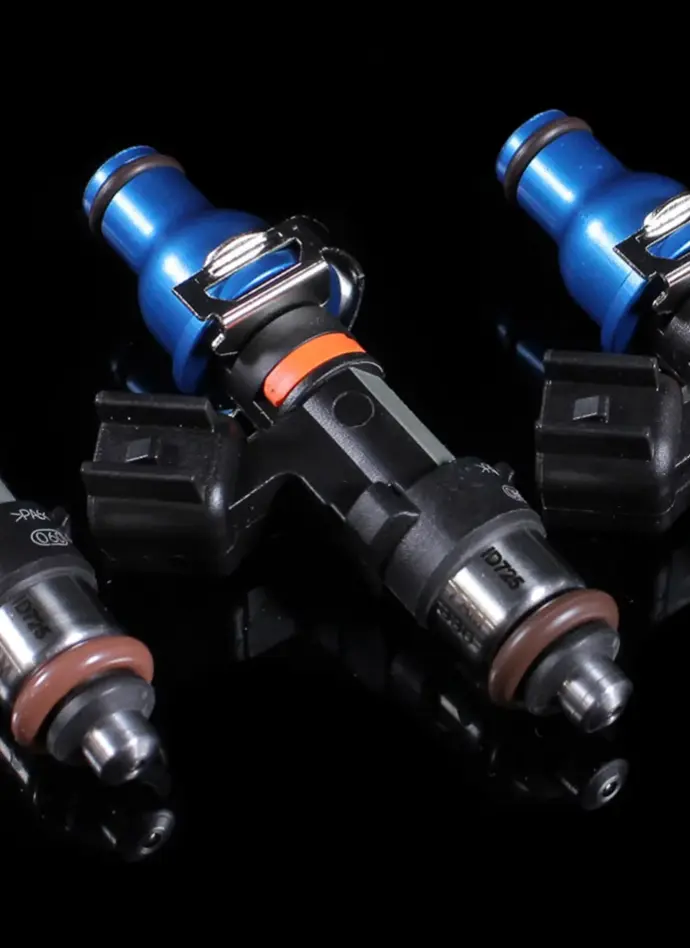
The injector card shows the required injector size per cylinder at your chosen duty cycle, in both lb/hr and cc/min.
- If you run more than one injector per cylinder, divide the suggested size by the number of injectors per hole. Or, if using different sized injectors in the same hole, subtract the primary injector’s rating from the requirement to get your secondary injector size.
- Both the lb/hr and cc/min values are presented as typical 3 bar (43.5 psi) ratings. If you run higher rail pressure, the actual flow at WOT will be higher than those rating numbers.
- Use these numbers as a starting point, then cross-check with your injector supplier’s data and confirm on the dyno or with datalogs.
7. Always verify in the real world
BSFC, lambda, and density values used here are representative for racing/performance use, not gospel for every combo. Real engines may need more or less fuel based on compression, boost, intercooling, camshaft, and how hard you’re pushing them.
This calculator is designed to get you in the right ballpark and to encourage sizing the fuel system on the safe side. Final decisions should always be validated with manufacturer data, datalogs, and—ideally—a competent tuner on the dyno.
Why this calculator exists
We see a lot of builds where the fuel system is the weak link. The turbo, engine, and ECU are all capable of big power, but the pump, injectors, or lines simply can’t keep up once boost and RPM are stacked together.
This calculator exists to answer a simple but critical question:
“For the power I’m targeting, on this fuel, how much fuel do I actually need, and what size pump, injector, and line makes sense?”
It’s there to give you a realistic starting point instead of guessing, or trusting a single flow number that was quoted at the wrong pressure and conditions.
How we do the calculations
Under the hood, the calculator is doing the same math a good tuner has in their head:
- BSFC (brake specific fuel consumption) – how many pounds of fuel per hour the engine needs per horsepower.
- Total fuel mass – horsepower × effective BSFC gives total lb/hr of fuel required.
- Fuel density – converts lb/hr into volume (gal/hr, L/hr, etc.) based on typical density for gasoline, E85, ethanol, or methanol.
- Injector duty – the more you want to limit duty cycle, the larger the injector you’ll need.
- Fuel pressure delta – used to translate “fuel needed at your rail pressure” into an approximate 3 bar rating for both lb/hr and cc/min.
For injectors, the calculator figures out how many pounds per hour each cylinder needs, then backs that down to “what size injector, rated at 3 bar, should I be shopping for?” based on your pressure delta and duty cycle.
For pumps, it looks at total volume required for the whole system, then lets you compare that to manufacturer pump flow charts at your real rail pressure.
About the suggested BSFC values
The BSFC values used here are based on typical ranges for performance engines, then nudged a bit richer so the suggestions land on the safe side:
- Gasoline – lower fuel mass per horsepower, but more sensitive to detonation.
- E85 / Ethanol – needs more fuel volume than gasoline, but offers more knock resistance and charge cooling.
- Methanol – needs a lot of fuel volume, but is extremely knock-resistant and runs cool.
For each fuel and for NA vs boosted, the calculator shows a suggested BSFC range and chooses a baseline in the safer half of that range. You can override the baseline if you have real data from your own combo, then use “Recalculate with new BSFC” to see how the recommendations move.
If you’re unsure, it’s usually smarter to assume BSFC is a bit higher (richer) than lower. A slightly oversized fuel system is almost always cheaper than a hurt engine.
Fuel line size suggestion
The fuel line sizing card uses the total fuel volume and the number of feed lines you plan to run (one main feed vs dual feeds) to suggest a conservative AN line size.
The calculator assumes typical flow limits for each AN size and always rounds up to the next larger line, so you’re not right on the edge. Think of it as:
“Given this much fuel flow, what’s a sensible feed line size to support it?”
On high-horsepower or alcohol-fueled builds, going one size larger than the minimum recommendation is often a good idea, as long as the rest of the system (pump outlets, filters, rails, regulator, and return line) is sized to match.
Final word
Every combo is different. Compression, camshaft, turbo size, intercooling, and how aggressive the tune is can all change the real fuel requirement.
This calculator is meant to get you into the right neighborhood and push you toward a safe fuel system, not to replace tuning, datalogs, or manufacturer data. Always sanity-check the outputs against injector and pump flow charts, and confirm in the real world.
When in doubt, more fuel system is almost always better than less.